Builds / recipe
Build your own meal planner
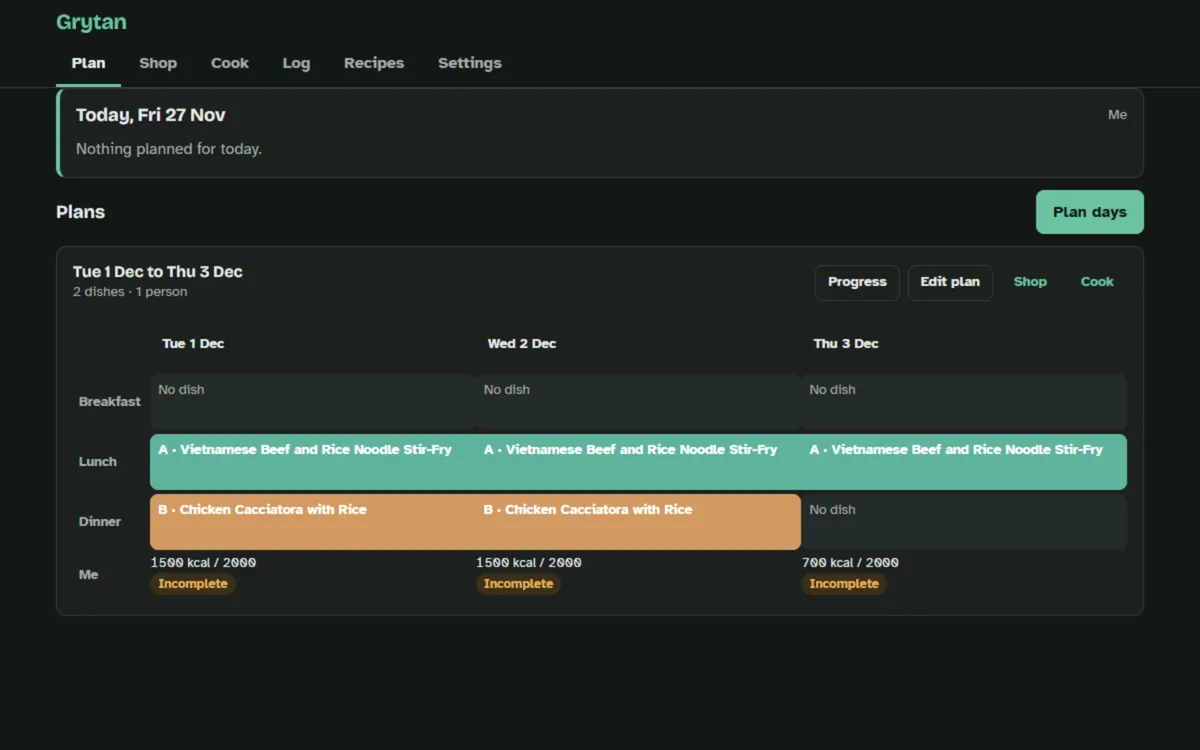
A simple meal planner that generates recipes against your calorie targets and an evolving taste profile. Pick a number of meals/days and generate a recipe, its resultant shopping list, and track your calories. Once you've tried the recipe, rating it improves the model's understanding of your taste.
- Status
- Tested: builds cleanly
- Size
- Large build, in two stages
- Runs in
- a Claude chat that can publish Artifacts
What it will ask you
- Who eats from the plan, and what is each person's daily calorie target?
- Which meals do you plan, and which get packed to eat somewhere else?
- How many days do you cook for at once, and how long can one dish take?
- Any allergies, intolerances or diets?
About a dozen questions in all, each with a default, so "keep default" always works. Every answer stays editable in the app afterwards.
What's already decided
- Claude writes the recipes and the page does every calorie and gram, because a model's arithmetic can't be trusted.
- One pot, many portions: each person's share is sized to their own target.
- Rule checks reject a recipe; soft targets like vegetables and fibre only warn.
- Ratings nudge your taste profile a little, and nothing becomes a "never" unless you say so.
Before you start
- You need
- A Claude account that can publish Artifacts with a shared database, Claude calls and sign-in.
- Usage
- Most of the build's usage goes to the nutrition table and the tests. Once it's running, writing one dish takes up to 8 Claude calls.
How to use it
- Copy the recipe with the button below.
- Paste it as the first message in a new Claude chat.
- Answer the questions, say yes to the plan, and Claude builds it.
Read the whole recipe
/anthropic-skills:grill-me
Build me a batch-cooking meal planner with an optional private food log as a claude.ai Artifact, tailored to me and the people I cook for. Claude writes the recipes; the page checks them and does every calorie and gram calculation, so each person gets a portion sized to their own target from one shared pot. The rest of this message describes the app. Interview me first, then write the spec, get my yes, and build in two stages: the planner first (published and live-tested), then the food log, only after my go-ahead.
If the grill-me skill is not available, run the same process yourself: ask the interview questions below a few at a time, write a short spec with acceptance tests, wait for my yes, then build.
0. Check before the interview
The app needs Artifact publishing, plus these runtime capabilities: db (shared database), sample (the page calls Claude; with image input for the food log's label photos), user (who is viewing, and whether they can write) and downloads (Export saves a file). Load the artifact-capabilities and artifact-design skills if they are available; otherwise read the Artifact tool's own capability docs and design guide. If the Artifact tool or any of these capabilities is missing, stop now and tell me, before asking any questions. Where those skills or guides disagree with an API detail in this message, follow them.
The national food database may be blocked by the network allowlist. If it is, the estimated nutrition table (section 3) is the normal path, not a failure: tell me which one you used.
Before the first question, tell me where the usage goes: the nutrition table, the tests and the review rounds cost the most to build, and using the app costs model calls too (writing one dish takes up to 8 calls). Do not estimate how long the build will take. Expect to confirm a few steps along the way. If I say I'm short on usage, offer to skip stage 2 or to use estimated table rows instead of a national database.
1. What to ask me
Keep to about 13 questions. Offer a default for each so I can answer quickly with "keep default". Sections 2 to 10 are already decided, so do not ask about them.
Every answer becomes an editable default in Settings (a field, slider, toggle or list), never a constant hard-coded in logic. Anything you decide for me without asking goes in the spec as an assumption and is also editable in Settings.
- Language, country and units for the app and recipes. (English, my country if known, metric; week starts Monday.)
- Who eats from the plan: a name and a daily calorie target for each person, any number of people. (One person, 2000 kcal, the food-label reference intake.) If I don't know a target, estimate one from age, height, weight, activity and goal, and mark it as a placeholder I can edit. Do not give medical advice.
- Which meals to plan, and each meal's share of the day. Breakfast, lunch and dinner are always offered; a share of 0% means "not planned". (Breakfast 25%, lunch 35%, dinner 40%.)
- How many calories each person eats outside the plan each day (snacks, drinks, a meal you do not plan), with optional different values per weekday. (0 kcal.)
- Which meals are packed to eat elsewhere: none, every meal after the first one a dish covers, or chosen meal types; and how you reheat there. (Every meal after the first; microwave.)
- Your kitchen equipment, and the most hands-on minutes you want to spend cooking one dish. (Oven and hob; 60 minutes.)
- How many days you usually plan, shop and cook for at once. (4 days.)
- Which carbs a meal may be built on, or "anything". (Anything, which turns the carb rule off.)
- Which proteins you eat, and how often each should come up. (Chicken, pork, beef, fish, eggs, tofu and vegetarian, all equally often.)
- Allergies, intolerances and diets. They become "always avoid" entries for the whole household. Matching is by ingredient name only, so it is not an allergy guarantee. (None.)
- Your tastes: cuisines you like, favourite dishes, and ingredients or cuisines you'd rather avoid. (No preferences yet, filled in later from "Describe what you like" and ratings.)
- Do you also want a private food log (stage 2), where each person logs everything they eat, planned or not, against their daily target? (Yes.)
- A name for the app and a visual mood. ("You pick" is fine.)
2. Core rules
- Claude writes, the page counts. The model writes recipes and reads food descriptions as structured data; the page computes every kcal, gram, portion and total from its nutrition table and never trusts a model's number.
- One pot, many portions. A dish is one base recipe for one serving that covers any set of planned meals in a session, cooked once as a batch. Each person's portion for each meal is scaled from their meal budget, so nobody cooks separately, and the cooked batch is divided by share, so nobody weighs cooked food.
- Checks reject, targets warn. Rule checks reject a generated recipe and send the errors back to the model as instructions. Soft targets (vegetables, fibre, daily protein) only warn, and imported recipes only get warnings.
- The cook's words win, but only where they were said. Order of authority: the planner's picks, then the session instruction, then the dish's own wish. A wish naming an ingredient makes it required. A wish, rating or note never becomes a standing "never" or "always" rule unless those words are used and the person confirms.
- Learning stays small. Ratings and notes shift weights a little, fade over time, and never grow the prompt without limit. The taste profile starts empty and evolves.
- Plans are frozen. A plan keeps a snapshot of the settings, people and nutrition rows it was made with. Changing Settings or the table never alters existing sessions.
3. Budgets, portions and the nutrition table
- Day budget per person = daily target - the outside-the-plan calories for that weekday. Meal budget = day budget × that meal's share. Settings shows the sum of the shares and warns when it is not 100%, but never blocks.
- Portion factor = meal budget ÷ recipe kcal per base serving, kept between 0.5 and 2.0. A portion that hits a limit gets a "badly sized" flag.
- Calorie window for a dish: from the largest budget it covers ÷ 2.0 × 1.02 to the smallest ÷ 0.5 × 0.98. If that is empty, use the mean budget ±10%. Aim at the mean budget, kept 10 kcal inside the window.
- A day is on target within ±10%, else over or under by N%. It is complete only when every planned meal has a ready recipe. Day totals include outside-the-plan calories, macros, fibre and vegetable grams. Optional daily protein and fibre targets per person warn only.
- Soft dish targets: vegetables 33% of raw weight and fibre 13 g per 1000 kcal; warn only below 75% of the target.
- Hand-checkable portions: round each line's grams first (one decimal under 10 g), compute each line's kcal from the shown grams, and make the portion kcal the sum of the shown lines. Each line shows its grams, kcal and the table value used, so I can check a portion by hand to the kcal.
- Start with all numbers in this section; they are editable.
Nutrition table (about 300-400 common ingredients for my country). Values are per 100 g edible part, raw: kcal, protein, carbs, fat, fibre, alcohol, plus a waste share (bone, peel, shell, 0-0.7) that converts to as-purchased grams for the planner. Also category, shopping section, piece and ml weights where useful, local-language aliases, carb type, protein type, counts-as-vegetable, availability (common, specialty, rare) and a trust level: sourced, estimated or verified, shown as a badge wherever the row is used.
- Source: look for my country's national food-composition database. If one exists with an open license, seed the rows from it at build time, store each row's source id, and credit the source in Settings as its license requires. If none is usable, generate the rows as model estimates marked "estimated" and run every row through the checks below. Tell me which you did.
- Macro check: kcal must lie between 0.95 × (4P + 4C + 9F) - 3 and 1.05 × (4P + 4C + 9F + 2 × fibre + 7 × alcohol) + 3.
- Category check: kcal per 100 g must be plausible for the category, e.g. vegetables 8-150, meat 100-360, cheese 90-430, oil 800-900, nuts 550-700, a range for every category, editable. Rows from a real database that fall outside a range are filed under "other" rather than widening the range.
- Estimates (for unknown foods): kcal ≤ 900, each macro ≤ 100 and together ≤ 101; if kcal disagrees with the macros, use the macro sum; ml density 0.3-2; then the category check. An estimate may only keep the vegetable, protein and carb flags its category allows (a protein bar is not a vegetable).
- Matching: names are matched loosely (case, accents, plurals, words like "fresh" or "chopped"); "garlic cloves" means garlic while "cloves" alone stays the spice. The same ingredient under two names is merged by summing grams.
- Growing the table: shared rows layer over the built-in ones (edits and verified ticks override, new rows add, a merge folds a duplicate into another row as aliases). Settings has search, a review queue of estimated rows sorted by the kcal they contribute to plans, a row editor, "Merge into" (confirmed), "Look up with Claude" and "Add from a label" (in my country's label order, saved verified after the checks).
4. Writing recipes with Claude
Recipe data: one base serving, with title, cuisine, main protein, boxable, reheat method, active and total minutes, 3-22 ingredients with raw as-purchased grams (0-800) and a role, 3-12 steps and batch notes. No other fields.
The prompt gives the dish's context (household, country, meals, equipment, packing, protein and cut, cuisine, carb, required ingredients, wish, energy aim and window, soft targets, preference summary) and an allowed list of "name kcal" for every allowed table row (always-avoid, rare unless asked, and disallowed carbs left out). Every number the prompt states comes from the same Settings the checks read, so editing a limit changes both. Hard rules: names copied exactly from the list; steps with no amounts; every ingredient used; lean cuts and modest oil; one main protein. Also:
- Par-boil potatoes and other dense vegetables before baking them with egg or sauce; roast vegetables hot and in a single layer.
- Name the dish plainly after what it is; no "crispy" unless it really is fried crisp.
- Do not repeat or closely imitate up to 30 recent titles.
- A dish covering a packed meal must keep in the fridge, travel in a box, and reheat with my method (or taste good cold).
Checks that reject (each error goes back to the model, naming the computed value and the biggest contributors):
- wrong shape, an ingredient listed twice, or more than 3 ingredients not in the table (up to 3 are estimated first)
- amounts in steps, including "2 minced garlic" (portions are scaled; the Cook tab shows amounts per step)
- a step names a table ingredient missing from the list (at most 3 errors; ignore salt, pepper, water, stock, same-category items, and a name inside a longer one: "butter" in "peanut butter")
- a main protein other than the planner's pick; under 60 g of it per serving (for vegetarian, eggs, tofu, legumes and cheese count); a second meat or fish not asked for; flesh in a vegetarian dish, including meat or fish stock, fish sauce, oyster sauce and gelatin
- a carb outside my allowed list (when the rule is on); an always-avoid ingredient (substring match, so "fish" also bans fish sauce; it beats a wish); a rare ingredient not asked for; a required or wished ingredient missing
- over 25 g dried spice per serving (wet pastes exempt) or over 6 g salt; raw weight per serving outside 220-1200 g
- kcal outside the dish's window; not boxable for a packed meal; a reheat method I don't have; active minutes over my limit
Generation loop: up to 3 attempts; each retry sends the previous errors (up to 8) and the rejected answer. Unknown ingredients are estimated in one quick-tier call and saved shared with an "estimated" badge. Write 2 dishes at a time and say so in the progress copy. A capability stop code (not granted, disabled, rate limited, expired) ends the run and marks the rest "Not started"; a rate limit also pauses generation for 60 seconds. Each dish's random choices use a seed from its id and reroll count, so retries send the same preference text. A dish with no budget fails before any model call.
Other model calls (quick tier unless noted):
- Wish ingredients: up to 5 ingredient names from a wish. Code also reads the wish: negated clauses are ignored, "X instead of Y" keeps X, named proteins, cuisines and carbs override the planner, and ingredient phrases like "greek yogurt" don't set a cuisine.
- Standing rules: only text with "always" or "never" becomes a rule (avoid or boost an ingredient, cuisine, protein or time), shown for confirmation first.
- Tastes (default tier): free text into cuisine weights, favourites, and prefer and avoid lists, confirmed; a "never" item joins always-avoid only if a pre-ticked box stays ticked.
- Notes to tags: 7 qualities (spice, sauce, richness, crunch, effort, filling, flavour), plus cuisines and table ingredients; "too dry" means more sauce, "hungry an hour later" means more filling. Never portion size or calories.
- Import (default tier): pasted text only; stay faithful, divide by the stated servings (assume 4), raw grams, steps without amounts; 2 attempts. Failed rule checks become warnings, and the planner won't pick that recipe on its own.
5. Planning a session
- A session is one shopping trip and one batch cook, covering 1-7 consecutive days from today or later. Each dish is cooked once, before its first meal.
- Plan sheet: pick the days, then it opens with one empty dish A: tap planned-meal cells to give them to the active dish. "Add dish" and "Suggest a split" create more dishes on request; nothing is pre-filled. Per dish: a protein (Any or one of mine), a cut-or-form picker listing the table rows for that protein (e.g. beef > mince), which becomes a required ingredient, and a short wish; plus one session instruction for all dishes. Settings may hold a preferred cut per protein. Show overlaps with existing sessions before writing.
- Any dish, any meals, breakfast included, on any number of days.
- Suggested split: a starting point only. Breakfast gets its own dishes; lunch and dinner run in time order, so a dinner's leftovers become the next lunch; run length by a variety setting (low 4 days, medium 2, high 1).
- Packing: the packing setting decides which covered meals are packed; dishes covering a packed meal must be boxable.
- Protein pick: weight (avoided 0, boosted +2; all 0 means all 1) ÷ (1 + 2 × times used), × 0.15 if already on the day. An optional preferred protein fills at least half the meals.
- Cuisine pick: household mean profile weight (+2 if boosted, avoided removed) ÷ (1 + 1.5 × times used). Each favourite dish at most once per plan. Carb: suggested by cuisine from my allowed carbs.
- Library reuse: about 1 dish in 3 comes from liked recipes without a model call: rated 4-5, nobody at or below the block line, not used in the last 2 plans, same protein and meal, passes this dish's checks, and no wish.
- Reroll keeps the protein, picks a different cuisine and carb, re-applies the instruction and wish, and avoids the old title. "Reroll with instruction" asks the scope: this dish, this plan, or always (a standing rule, confirmed). Cook ticks reset on reroll.
- Past days are read-only; "Edit anyway" unlocks the session and marks it edited after the fact. A dish never loses its last meal except by Remove (confirmed); an empty session is deleted. A planned meal can take a library recipe (never a blocked one).
- A new session overlapping one session merges into it; overlapping several trims those days out. A merge that would add a meal the frozen plan had at 0% is refused with an explanation.
- All weights, rates and factors in this section are starting points, editable.
6. Learning from ratings and notes
- Each person rates recipes 1-5. 4-5 can return. A recipe rated at or below the block line (2, editable) by anyone never returns, with "Allow again". A gap of 2 or more shows "you disagree". A 1 on a current plan offers "Replace this dish now?" with a Reroll button; nothing runs without that tap.
- Rating nudge: the cuisine weight (matched to the Settings cuisine list first) and each main-role ingredient weight move by ±0.25, clamped 0-5; re-rating applies only the difference. A note with a reason takes back half of the nudge. Read the rating and profile after Claude answers, so a slow note never reverts a rating tapped meanwhile.
- Notes: each tag moves its weight by 0.5, capped at ±2, faded × 0.9 at each new session (not on merges), used from 0.25, pruned under 0.05, at most 6 ingredients each way and 4 qualities. A leaning under strength 1 reaches each dish with that probability. Re-saving a note first undoes the old one exactly. "Filling" starts neutral and is only learned. Settings lists what was learned, with Forget.
- Preference summary in each recipe prompt, bounded: top 6 cuisines, up to 12 preferred and 12 avoided items, up to 5 recently disliked titles, and the learned lines, which are small adjustments to apply quietly, never the theme of the dish. Never list favourite dishes or liked titles: their words leak into unrelated recipes.
7. Screens (stage 1)
Tabs are buttons, not in-page links (some viewers block those): Plan, Shop, Cook, Recipes, Settings, and Log after Cook in stage 2. UI copy explains each rule plainly and reads its numbers from Settings.
- Plan: a Today card with the viewer's meals (raw grams, kcal, cook today or from the batch, reheat); a person switch when there are several people. Desktop: a 7-day grid, dishes as bars across days, a kcal row per person; phone: a day-by-day agenda. Days show on target, over, under or incomplete; dishes show their writing state with Retry where it failed or stalled. Meals a frozen plan covers stay visible even if their share is now 0%.
- Progress sheet: per dish, from library, checked, retrying (attempt N of 3) or failed with the errors and Retry; then plan flags and a link to the shopping list.
- Recipe sheet: badges, meals covered, a portion table for every person, the viewer's scaled ingredient lines, stars and a note, and the change actions.
- Day sheet: per person, outside-the-plan calories, each meal, total against target, macros, fibre density and vegetable grams.
- Shop: per session, lines grouped by shopping section in store order, with total raw grams, pieces where useful and an "estimated" badge. A shared "Have it" tick moves a line into a collapsed list. Show what is left, and warn when some meals have no recipe yet.
- Cook: recipe by recipe, with whole-batch amounts, batch notes and reheat. Each step shows the amounts of the ingredients it uses (full names first; ignore verb uses like "oil the tray"). Shared step ticks. A packing list per person and meal: raw grams and share % of the cooked batch, packed meals as "box N of M".
- Recipes: the library with search, rating filter and a detail sheet (nutrition from today's table, ratings, Allow again, delete; sessions keep their own copy). Add a recipe: paste, choose meal types, review the warnings.
- Settings: every interview answer, soft targets, every rule number, the taste profile with "Describe what you like", learned items, and the nutrition table. Values I did not set show "placeholder - confirm", with "Confirm all". A daily target under 800 kcal is refused, and under 1200 kcal warns once per person to check it with a doctor or dietitian. State that targets are my own numbers, not medical advice. Next to always-avoid, state that matching is by ingredient name only, so it is not an allergy guarantee: check labels yourself.
- Who are you: on first load each signed-in person picks their profile once (skipped with one person), saved in their own private area, then is pointed to "Describe what you like". Settings has "Switch who I am".
8. Stage 2: the food log (only if I said yes)
Its purpose is an honest daily total, so food eaten outside the plan must be as easy to log as planned meals.
- Log tab: one day at a time: target, eaten, remaining (target - everything logged; the outside-the-plan setting is not used here and stays manual), a meter, protein and fibre against the optional targets. Day arrows and Today; no future days. A Monday-Sunday week strip: kcal per day against target and "N of 7 days logged".
- Private: each person logs only their own food, stored in the platform's private per-account area, never in a shared path, with "Only you can see your log". Without a signed-in account the log stays in memory for the visit, with a banner. A failure opening the private log falls back to memory and must never stop start-up.
- Free text (quick tier, up to 1500 characters): the model returns only food names and grams, a "guess" flag for vague amounts and a "fried" flag. Long chatty text must work; punctuation does not split foods; a branded or fast-food item is one line that keeps its brand; a known table name is used only for the same food in the same form (fresh vs canned, dry vs cooked), and cooked starches are named as cooked. Grams are the edible part as eaten, raw for foods I cooked. Grams must be over 0 and at most 3000.
- Review before saving: a list of lines (name with table autocomplete, grams, kcal, tags guess / estimated food / guessed oil), each editable or removable, plus "Add a line". Nothing is saved until Save; unknown lines block Save. Unknown foods get one estimate call that includes my own words, so a branded product is estimated as that product. They join the shared table as estimated without who or when, and the sheet says new food names are visible to the household.
- Frying oil: when the text says fried (in my language too) or a line is flagged fried, and no fat is named, add an oil line of 5 g per 100 g of the fried food, marked guess (amount and oil type editable in Settings).
- Log kcal = grams × the edible-part value, with no waste share taken off (unlike planner grams). Computed from the current row, so correcting a row corrects old days; keep a frozen copy only for a deleted row.
- Planned meals for the day are listed and count only after "Ate it", with Half, As planned, 1.5x or custom; recomputed from the plan's frozen snapshot, so it equals the Plan tab's portion.
- Recents and favourites re-log in one tap via the review. Any saved entry can be edited or deleted (confirmed).
- Packaged food from a label photo (default tier, image): the model reads per-100 g values and the brand and product name; typed values win over a slower photo read; same checks before saving. A photo-read row saves as "estimated" unless I tick "I checked these against the label". Then it opens the review with that food, so it is actually logged. If no photo picker opens (some phone apps), say so and suggest typing the values.
9. Technical
One self-contained page, published privately, capabilities {db, sample, user, downloads} in stage 1, with image input on sample added in stage 2. Develop as separate source files built into a single HTML file: pure logic with no DOM or network (random choices use an injected generator), model calls with sample injected, UI and state, styles, the nutrition table. Do not minify, and write a short comment explaining why for every rule, number and fix.
Settings has an export that saves all my shared data and my own log to one file, and an import that restores it. Before any change that alters how data is stored, remind me to export first.
Keep file inputs (photo pickers, import) outside any area the page re-renders: a re-render while the picker is open loses the chosen file.
- Shared collections (settings, people, profiles, recipes, plans, ratings, shopping and cook ticks, custom table rows), one live subscription each, with the schema documented in a file published with the page. Follow the platform's path rules (collection and document paths differ in segment count), and make the test stand-in refuse wrong-shaped paths like the real database.
- Write locally first, then keep an ordered list of operations per document, sent one at a time, each once; show unconfirmed operations on top of incoming snapshots until a snapshot reflects them. An update to a missing document becomes a set. Ticks and settings write only the changed fields, so two people editing at once both keep their change; settings writes wait until settings have loaded. A dish being written saves only its own dish onto the latest stored plan.
- A device id kept in browser storage marks which device is writing a dish and when it last moved: another device's dish shows "being written on another device", then "stalled" with Retry after 6 minutes without progress; this device's own unfinished dishes show stalled after a reload, and "Write missing recipes" skips dishes another device is writing.
- Everyone eats every planned meal. Each person uses their own Claude account, linked to one profile; ratings, notes, learning and logs are per person. Only the person edits their own taste profile.
- Any capability may be missing: banners for not connected (memory only), view only, identity unknown, storage full, and Claude unavailable (saved plans, the shopping list and all calculations still work). Generation runs in the page while it stays open.
- Re-rendering keeps focus, cursor and scroll while I type. Rendering has a timer fallback, because hidden tabs pause animation frames.
- Escape all model and user text. Wrap every piece of user text that reaches a prompt (wishes, notes, names, taste lists, titles, meal text, pasted recipes) in delimiters it cannot close, length-capped.
- Mobile first, 44 px tap targets, light and dark themes, reduced motion.
10. Changing it later
I will want changes after using it for a while. Make that safe:
- Settings has a short "Changing this app" note: open the artifact's chat (or a new one with the published link), and say what to change, adding "keep my data".
- Every later change keeps my saved data. Republish to the same artifact: a new artifact starts with an empty database. If a change alters how data is stored, migrate the existing data instead of resetting it, and tell me before publishing.
- Keep a short changelog with the page (what changed and why), so later changes don't undo earlier fixes.
11. Definition of done
Write automated tests for the pure logic and the pipeline, using a stand-in model that also returns bad output. Check Node first, and ask me before installing anything. The tests must cover at least:
- one and three people: portions per meal, the calorie window, the 0.5 and 2.0 limits; a portion's kcal equals the sum of its shown lines on a recipe with about 20 ingredients
- a 0% share removes that meal from new plans but not from frozen ones; shares not summing to 100% warn but still save; a weekday override changes only that day
- a target under 800 kcal is refused and under 1200 warns once; an allergy entry rejects a recipe containing it, even when a wish asks for it
- a dish covering breakfast and lunch on 5 days is accepted; each of the three packing settings; the active-time limit
- each rejecting check, including "2 minced garlic", "peanut butter", meat stock in a vegetarian dish, a missing claimed protein and a missing wished ingredient; the carb rule off with "anything"
- retries send the errors and the same seeded text; estimate checks and category flag trimming
- rating rules, the nudge and half take-back, note fade and exact undo; a 1 rating rerolls nothing without the tap
- a stop code ends the run; concurrency is 2; two runs on one plan both keep their dish; one person's untick survives another's tick
- stage 2: model kcal is ignored; "protein bar, some brand" stays one line; the oil guess (and none when butter is named); "2 eggs" loses no shell share; cooked rice is not counted as dry rice; "Ate it" at As planned equals the Plan tab portion; a log never lands in a shared path
Run the page locally with the stand-in (with a banner saying so) and click through every screen at phone and desktop widths, with two tabs for shared ticks. If you drive a headless browser, launch it so it never asks for an OS keyring or password (Chromium: --password-store=basic --use-mock-keychain). The build must refuse to include the stand-in in the published page. Then publish, and give me the link.
The stand-in cannot prove real model quality, real sync, real private storage or real photo reading, so report plainly what you tested and what you did not. Then walk me through a live test. Stage 1: plan one day with one dish, check one portion's kcal by hand from its lines, then plan a typical session. If more than one person uses it, tell me how to share the artifact with edit access (invited by email as Editor, no public link, which would make them view-only), have the second person pick their profile, tick a shopping line and rate a recipe to confirm sync and Claude access. Stage 2: log a chatty off-plan meal with a branded item, tap "Ate it" on a planned meal, confirm the second person cannot see my log, and add a packaged food from a label photo on desktop and on a phone. Fix what fails.
Made with the recipe plugin. Back to Builds